
MUJI started selling homes in 2004 in Japan with the introduction of “木の家 (Ki no Ie, Wood House)” to provide a simple, universal, compact yet highly functional and flexible platform that could last for decades. In 2019, it added its forth product 陽の家 (Yō no Ie, Sun House), marking its 15th year anniversary in the house construction business. What is unique about MUJI HOUSE? There are a few important qualities.
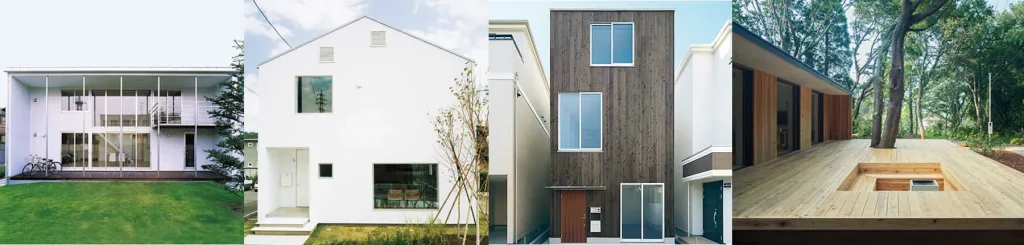
From left: The Ki no Ie (Wood House, 2004), the Mado no Ie (Window House, 2007), the Tate no Ie (Vertical House, 2013),
and the Yo no Ie (Sun House, 2019) (Images courtesy of Ryohin Keikaku)
MUJI HOUSE design philosophy
MUJI house is fundamentally different from conventional home products, because its main value is its strategic smallness. Long before the tiny house movement, it’s been offering houses that were around 1,000 square meters.

MUJI house’s design concept, which hasn’t changed since 2004, is “長く使える、変えられる (provide maximum flexibility for long-term use).” It counters conventional housing market in Japan, where average life of commercial homes had been only about 20-30 years, which were divided into small rooms, making it difficult for owners to accommodate changing family needs and priorities. Determined to provide a house that can stay reliable and relevant for owners for decades to come, MUJI chose a “一室空間 (one-room house)” supported by sturdy and durable framework. MUJI’s homes have a minimum number of structural columns and no load-bearing interior walls, which means that the floors are uninterrupted and pieces of furniture can used as flexible room dividers. You are free to change the layout anytime you want.
The concept of the “one-room house” comes from the “Series of Box-Houses” designed by architect Kazuhiko Namba in 1995. He believed that simple, no-frill “box” houses could be replicated in any places, especially in urban settings, accommodating unique geographical and social environment. Namba also imagined that simple but highly functional homes can be changed and/or improved by owners and adapt to the surroundings as if they were a living organism.

MUJI HOUSE Basic Features
SE Structure
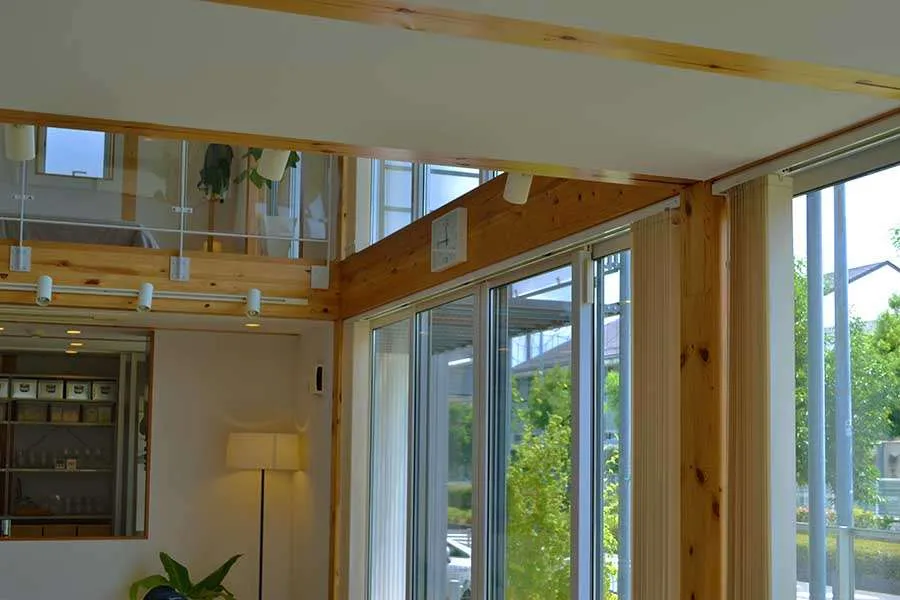
As mentioned, a sturdy structure is the foundation of MUJI house. MUJI leveraged traditional Japanese style, in which load is born by exposed columns and beams. Shoji and/or fusuma was installed in between the columns as flexible partitions, as no load-bearing interior walls were needed. Traditional Japanese style offered maximum flexibility, but it was structurally vulnerable and provided little insulation. In order to overcome these shortcomings, MUJI introduced the SE (safety and engineering) structure, which used a combination of engineered/enhanced wooden slabs and uniquely designed joints/fasteners to realize rigid-frame structure. Originally developed to enable the construction of large-scale wooden buildings such as stadiums, the SE structure had a track record to support MUJI’s concept to provide durable homes with natural and warm ambience coming from exposed wooden slabs.
The SE structure also lets you remove the majority of upper floors without sacrificing the sturdiness. By reducing the floor area of the upper floor, MUJI house provides vertical openness that helps overcome the overall size limitations. It is a default design in most MUJI houses.

Insulation
With no interior walls and most upper floors removed, the entire house is connected in terms of air circulation. That’s why MUJI puts so much emphasis on insulation: they believe that it is imperative to un-compartmentalize and un-stratify the air throughout the house so that the residents can stay comfortable no matter where they are, with minimum amount of energy.
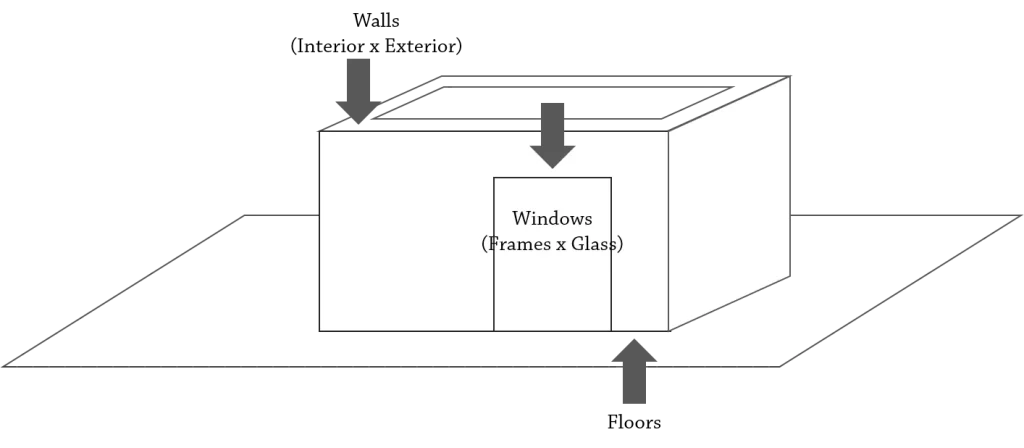
There are three focal points for enhanced insulation in MUJI house.
- Walls (both the interior and exterior)
- Glass and frames of the windows
- The floors underneath the glass doors
Walls
Insulation panels made of low thermal-conductive phenolic foam (which has thermal conductivity value of 0.020W/mK) is sandwiched between the exterior and interior walls. The particles of phenolic foam are very small in size, therefore can minimize the amount of heat traveling through it. But that’s not the only wall insulation installed in the MUJI house. The voids between the load-bearing pillars just behind the interior walls are filled with fiber glass in order to eliminate the paths through which warm/cold air could leak outside.
Windows and floors
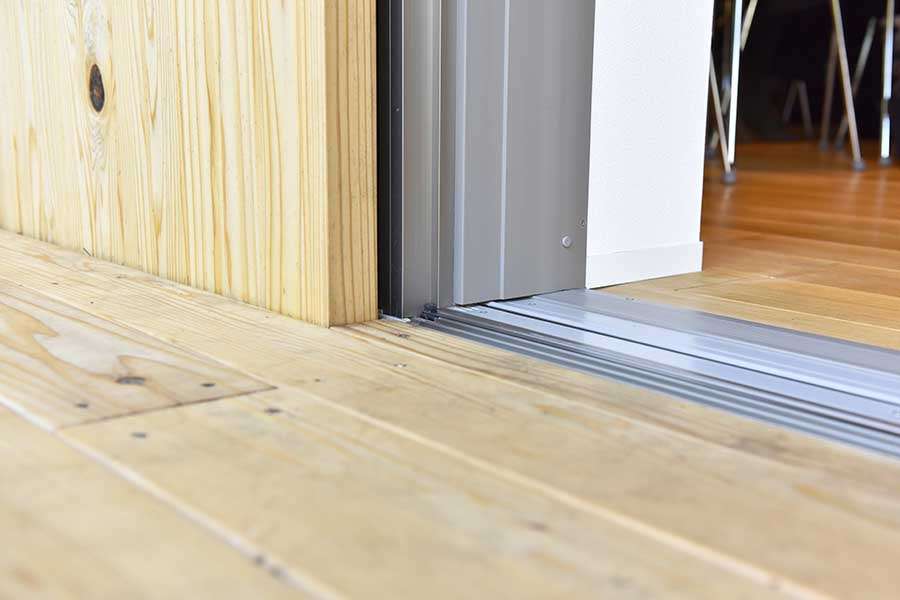
Window areas are a critical target of insulation for a MUJI house that has large/tall windows that occupy large surface areas. (In case of the Ki no Ie or Yo no Ie, almost the entire surface area of one dimension is glass windows.) Air can leak through glass itself, frames or floors. MUJI takes care of all three.
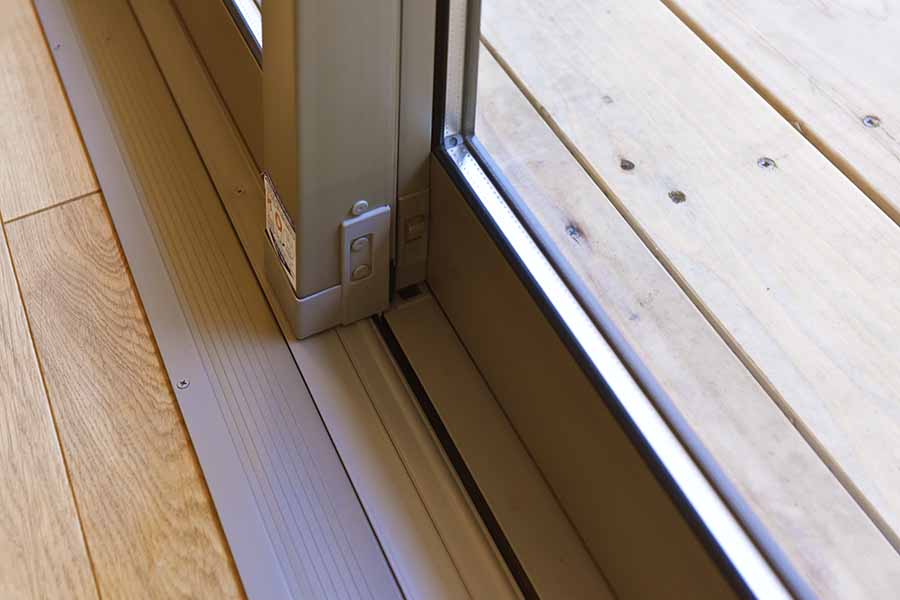
- Glass: MUJI uses tripe layered glass, in which voids are filled with low-conductive argon gas.
- Frame: In general, energy can travel through the frame areas faster than glass. MUJI house maximizes the glass area by burying the frames inside the walls.
- Floors: We all know that the floor near windows/doors can easily get cold/hot. MUJI house has layers of small air chambers underneath the floor where cold/warm air can be trapped. It also uses a supporting structure under the floor that uses the combination of aluminum and resin to effectively slow down heat transfer from inside to outside or vice versa.

Air
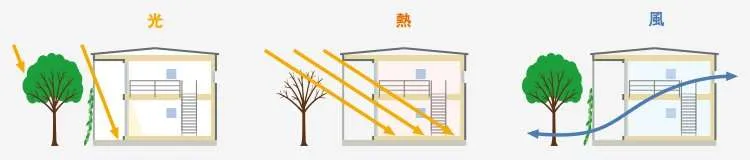
MUJI House is also conscious of the surrounding environment and takes advantage of it so that people can live comfortably using the minimum amount of energy. Based on the concept of the “passive house”, MUJI conducts an evaluation of the environment including geographical setting, local microclimate, orientation of the house and pathways of wind. The results not only inform the design details such as the places/size of windows or how to plant shade trees in the backyard, but also helps people make the most of the blessings of nature – they have a much better idea as to when to open windows and let breeze in, or use sunscreens to avoid the direct sun.
Ramification is significant because not only you need to spend less energy on HVAC equipment, but also you could learn to live without it when not needed.
MUJI HOUSE products
The solid foundation is the common denominator for MUJI house, but the four models that are currently offered have different goals to accommodate peoples’ different needs and priorities.
木の家 (Ki no Ie, Wood House) 2004
木の家 (Ki no Ie ) is MUJI’s first model and best-selling house. As mentioned, it is based on the “Box House” designed by architect Kazuhiko Namba and pursues the “one-room house” system. A typical Ki no Ie has a kitchen, bath and living space on the first floor, and bedrooms and a bath on the second floor.
When it’s owned by a family with two young children, the needs for partitions are minimal. Children can play anywhere in the house, and the family can spend as much time together as they want – to eat, to sleep or to do activities. The high-rise windows strategically face south, so that they can enjoy cool breeze in summer and warm sunlight in winter. The basic Ki no Ie can come in as small as 9.1m x 7.28m (66.3 m2).
When owned by a couple of empty-nesters, the design can be tweaked so that they can focus on their own enjoyment. If they want to socialize with neighbors, the entrance area can be extended and enhanced so that it can become a small “community” room, or storage area for gardening. Read more on the Ki no Ie here.
窓の家 (Mado no Ie, Window House) 2007
窓の家 (Mado no Ie, Window House) was inspired by traditional cottages in the old villages in the Cotswolds, in south central England. It is a community in which the neighbors have been sharing the same aesthetic standard, building uniform houses with charming triangular roofs, and taking care of gardens with English roses. In such an environment, the entire community is part of your life, so you want to enjoy it, even when you are inside your house. That’s where picture windows play a pivotal role. Mado no Ie lets you install almost frame-less looking, highly insulating, clear windows wherever you want, large or small. Windows are part of the wall and always the part of the conversation.
縦の家 (Tate no Ie, Vertical House) 2013
縦の家 (Tate no Ie, Vertical house) was imagined as a solution for the super-urban setting in which land is prohibitively expensive. Coming in about barely 3.64m x 8.19m, Tate no Ie offers six “skip” floors that are loosely connected, surrounding the central open areas. You can assign roles to those six components – kitchen, bed, bath or office – and arrange them as you like. Tate no Ie attempts to defy the limitation of space and transforms itself into a comfortable living space. MUJI’s focus on insulation and air circulation plays a critical role to keep the indoor air quality comfortable in this narrow, vertical house that could easily be surrounded by tall buildings in a super-urban location.
陽の家 (Yō no Ie, Sun House) 2019
陽の家 (Yo no Ie, Sun House) is MUJI’s first single-story house that primarily assumes rural living. It’s a bold step for MUJI to extend its customers from its traditional base that has have been urban/semi-urban residents in their 20’s or 30’s. Kenya Hara, who supervised the Yo no Ie says : “It nailed every detail so that you can live in harmony with the surrounding environment. It can be your last home to live.” Read more about Yo no Ie.