

Tai-an, the origin of tiny tea hut
Legendary tea master Sen no Rikyu (1522-1591) is the founder of “wabi cha” and played a decisive role for the emergence of wabi sabi culture, art and philosophy. One of Rikyu’s famous projects that remain today is 待庵 (Tai-an), the smallest and humblest chashitsu (tea hut) made by applying bricolage philosophy. (Read about Tai-an) Inspired by Tai-an, Sugimoto built a tea hut named 雨聴天 (Ucho-ten). 雨 means rain, 聴 means listen, and 天 means sky.
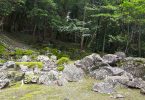
To enter the chashitsu area, you need to go through a gate made of natural rocks. According to Sugimoto, ancient Japanese used rocks to make 鳥居 (torii), which has been used to set a boundary between our world and sacred or divine areas. Torii is usually set at the entrance of jinja (shinto shrine), the premise of which is considered sacred. Sugimoto designed this rock torii for his chashitsu inspired by the ancient remains in Yamagata prefecture.


Sugimoto imagined Uchoten as 本歌取り (honka dori) of Rikyu’s Tai-an. Honka dori is a technique used in waka (traditional Japanese poem): it borrows ideas from classic waka, add additional/contemporary essences to elevate it to a new level. Tai-an is believed to have been built on a battlefield as a makeshift tea hut. Because of that, it leveraged the ultimate smallness (only 2 jo or about 3.6 square meters), and only used materials readily available on-site. Sugimoto took the essence from Tai-an inspired by honka dori method. For example, Uchoten has the exact same measurements as Tai-an.




Leave a Comment