
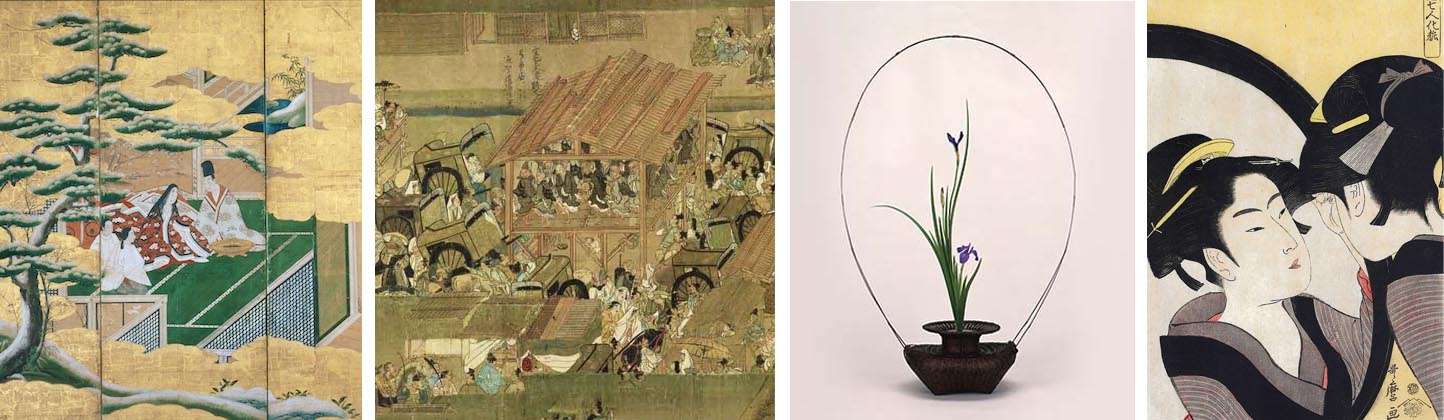
Japanese aesthetics are known for simple and minimalist design principles and appreciation of natural beauty. “History of Japanese Aesthetics” reviews four periods that played critical roles to cement them: 1) Heian, 2) Kamakura, 3) Muromachi and 4) Edo period. You are on Muromachi period.
The Muromachi era (1336-1493)
Muromachi is probably the most important era for Japanese aesthetics, because it’s when the notion of wabi-sabi emerged as Japanese society was going through drastic transformation. It was through unprecedented social turmoil when Japanese art saw unparalleled culmination through radical subtraction of elements, which can be compared to modern abstract art.
The harbinger of cultural leap
In the previous chapter, we discussed that the Kamakura era, a period that preceded the Muromachi era, was ridden by warfare and social unrest, famines, pandemics and natural disasters. Influenced by series of tragedies, Kamakura culture was defined by “mujo,” the notion that everything in our world would be transient and eventually gone, and nothing was absolute nor ever-lasting. Kamakura era can be compared to Europe’s Dark Ages, and interestingly enough, both seemingly bleak eras were followed by a cultural leap: the Renaissance in Europe and wabi-sabi in Japan. What was the decisive factor that transformed the “dark” ages into the pinnacles of pre-modern cultures? Simply put, it was an economic leap.
During the Renaissance Italy, tycoons like the Medici family emerged to establish influential European-wide financial networks that accelerated international trades. With enormous fortune, Cosimo de Medici (1389 – 1464), the father the Medici “dynasty,” grabbed the political power of the Republic of Florence and transformed it into a vibrant cultural hub. By the same token, Ashikaga Yoshimitsu (1358 – 1408), the third shogun of the Muromachi dynasty, aggressively promoted international trade with China and boosted Japanese economy to the unprecedented level. He invested in emerging artists, who ended up cementing traditional Japanese aesthetics as we know today. Intriguingly enough, both Cosimo and Yoshimitsu had a grandson who elevated respective cultures to the next level: Lorenzo de Medici, the great patron of the greatest Leonardo da Vinci and Michelangelo, and Ashikaga Yoshimasa, whose artistic circle was the master mind of wabi-sabi aesthetics.


The lives of Cosimo-Lorenzo and Yoshimitsu-Yoshimasa almost overlapped, and their unparalleled contributions to economic and artistic leap were almost identical. However, there was one big difference between the Renaissance and wabi-sabi: the first celebrated various aspects of being humans – humanism -, but the latter appreciated the limitations, or insurmountable nature of being humans. What made such a huge difference?
Christianity or Buddhism (Zen)?
One apparent factor is religion. The value system in the Middle Age Europe was controlled by the Catholic Church, so there weren’t much wiggle rooms for each individual to publicly express his/her own desire or aspirations through art. However, growing economies produced tycoons, who started leading the society with their financial power. Living conditions of general people also improved, which helped reduce fear for the afterlife. They began to feel that there should be more diverse values in the world other than leading a pious life to be saved once they died. For the first time in centuries, they were ready to pursue pleasure and unique potential resided in them. Such impetus triggered humanism, which found the ancient Greek and Rome, or pre-Church perspective, their North Star. In a sense, the Renaissance was about re-discovering the world in its “natural” state, not through the lens of Christianity. The Renaissance was about re-discovering our body and soul as is, and nature’s body and soul as is.
Meanwhile, in Japan, people always looked things in “natural” state, which the core teaching of Buddhism. According to Buddha, the natural state of our world was mujo: a boundless universe of nothingness (or absolute relativity), in which there was nothing permanent nor absolute. Japanese found beauty in the transient/elusive quality of things – in nature, in relationships, in life. This symbolic difference was further deepened by one event that rattled Japanese society in the middle of the 15th century, during Ashikaga Yoshimasa’s tenure.




Leave a Comment