
The Battle of Bun’ei (Bun’ei no eki)
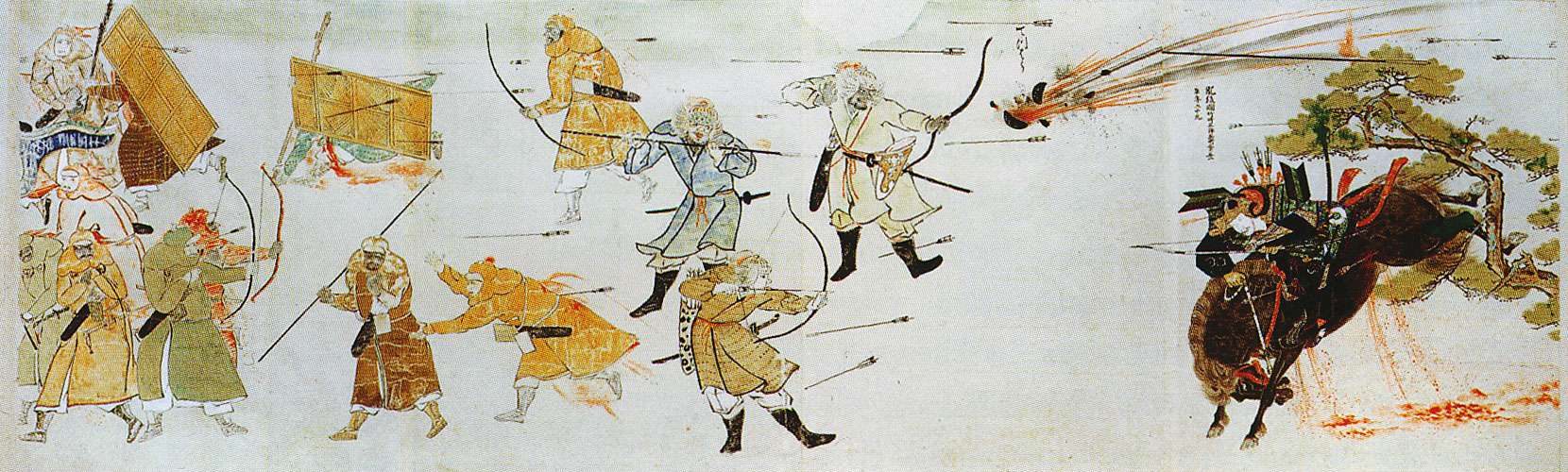
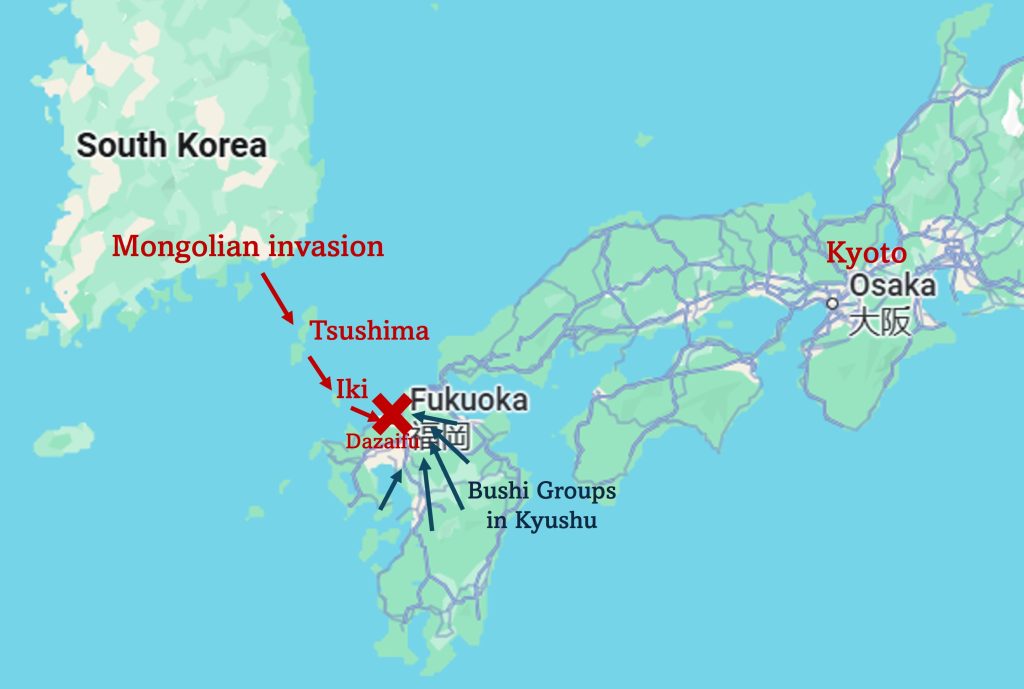
In October 1274, the Mongol and Korean joint army left the Korean Peninsula and arrived at the island of Tsuhima and Iki, where they mercilessly killed local people. When Japanese foreign ministry in Dazaifu learnt about the atrocity, they scrambled and called bushi (samurai) warriors within the Kyushu region. They met the Mongol troops who landed on the mainland Kyushu via Hakata Bay.
It is believed that the Mongols overwhelmed Japanese bushi groups for multiple reasons. Most notably, Japanese were inexperienced to face foreign armies as the country never faced serious invasion threats before. Because of that, they made a costly mistake to encounter the Mongols. Without realizing that their war protocols were too unique, bushi started the battle by “名乗り (nanori,)” which was a ritual to say out loud one’s identity – who he was, who his boss was and where he was from. Though it seems an odd practice, they were paid based on the number of enemies they killed, and nanori was used so that other bushi could to help them count that number.
If Japanese bushi fought against other Japanese bushi groups, both would do nanori. However, Mongols wasted no time to start attacking defenseless bushi in the middle of nanori. There was other issues with Japanese: they wanted to fight individually because rewards would be assessed individually. It made them vulnerable against the Mongols who fought efficiently and effectively as a group. In addition, they didn’t have firearms like the Mongols.
Legend of Kamikaze
Japanese bushi groups were too naïve to face the strongest army in the entire Eurasian continent. It would have been really difficult for them to find a breakthrough.
But then, a miracle happened.
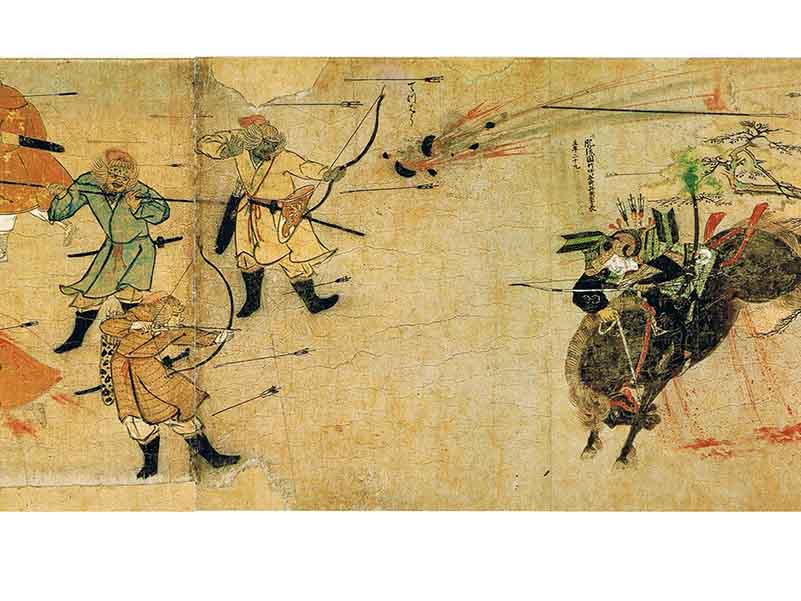
The next morning following harrowing battles, Japanese saw something unthinkable: the Hakata Bay (in which Mongolian ships were anchored) was completely empty. Out of the blue, the Mongolian ships were all gone.
This is where the legend of kamikaze started. People believed that there was a divine storm (kamikaze) during the night, which swept Mongolian ships. (“Kami” means divine and “kaze” means wind or storm.)
But what exactly was the “kamikaze?” One possibility is typhoon, a large tropical storm which would have been powerful enough to sink the entire convoy. Kyushu area is hit by typhoons very often. However, the battle of Bun’ei took place late fall/early winter. The typhoon season in Kyushu is summer.
Then what are other possibilities? Actually, there is no record in Japan about a storm in fall/winter of 1274 that hit the Hakata Bay. On the other hand, Korean records show that there was a storm that sank most of the Mongol/Korean convoy. That discrepancy suggests that the convoy might have encountered the storm after it left the Hakada Bay and was on the way back to Korea.
We will never know the truth, but it’s most likely that the Mongols decided to leave Japan before entering into all-out warfare. There is a theory that they’d planed the Battle of Bun’ei as a demonstration anyway, and the early retreat was part of the plan. There is yet another theory that the Mongols decided to leave because they encountered an unexpectedly fierce resistance from Japanese warriors.
Whatever the reason was, the Mongols left Japan, and the storm hit their convoy afterwards. And because the way they vanished from Hakata Bay was so dramatic, the incident was exaggerated and the spread throughout the country to became a legend. Japanese ended up using the story to believe that their country was protected by the supreme power.






Leave a Comment